Why PCOS Causes Unwanted Facial and Body Hair
If you live with polycystic ovary syndrome (PCOS), you will know that unwanted hair on the chin, upper lip, cheeks, neck, chest or abdomen can be one of the most frustrating and upsetting parts of the condition. You are not imagining it, and it is not simply a cosmetic nuisance. It has a clear medical cause.
PCOS is one of the most common hormonal disorders in women of reproductive age. Many women with PCOS have higher levels of androgens (often called male-type hormones) or increased sensitivity to them. These androgens act on hair follicles in certain areas of the body and convert soft, fine vellus hair into coarse, dark, terminal hair. This male-pattern hair growth in women is known as hirsutism.
According to the 2023 International Evidence-based Guideline for the Assessment and Management of PCOS, hirsutism is one of the most reliable signs of androgen excess and affects a significant proportion of women with the condition. In India, where cultural expectations around smooth, hair-free skin can be strong, this symptom often causes considerable distress even when the amount of hair is modest.
Hirsutism vs Ordinary Hair Growth: What’s the Difference?
Every woman has body hair, so how do you tell the difference between normal hair and PCOS-related hirsutism? The distinction matters because it guides treatment.
- Ordinary hair growth is usually fine, soft and lighter, spread across the body in a pattern typical for women.
- Hirsutism involves coarse, dark, terminal hair appearing in a male-pattern distribution – the chin, upper lip, jawline, chest, abdomen, lower back and inner thighs.
Doctors sometimes grade hirsutism using the modified Ferriman-Gallwey score, which rates hair density across nine androgen-sensitive areas. In practice, this score has limits, because most women already remove their hair before seeing a doctor. For this reason, current PCOS guidelines emphasise that if the hair growth is distressing to you, that distress alone is a valid reason to seek treatment, regardless of the exact score.
Hirsutism develops gradually, often over months or years, and can become more noticeable with weight gain or worsening insulin resistance, both of which can amplify androgen production.
How Laser Hair Reduction Works
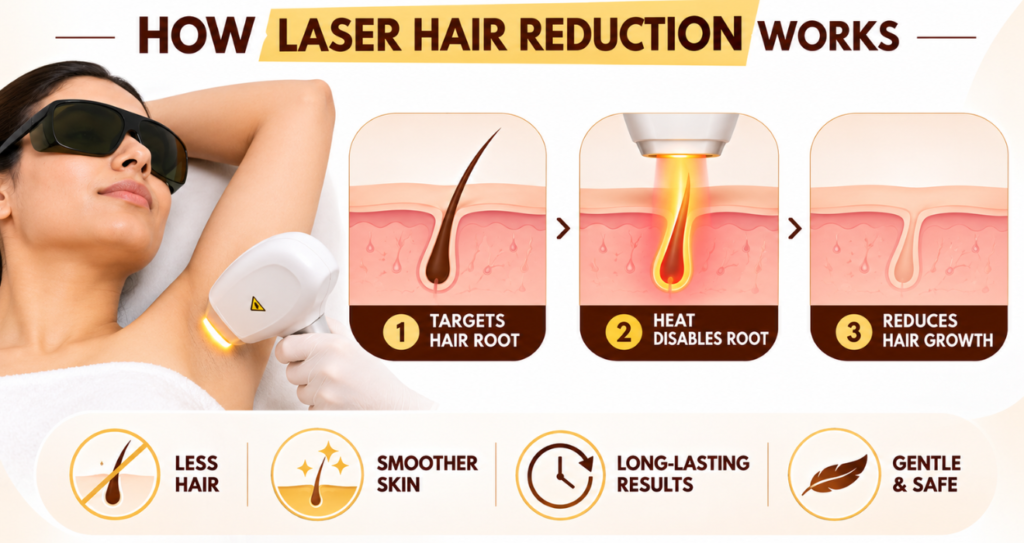
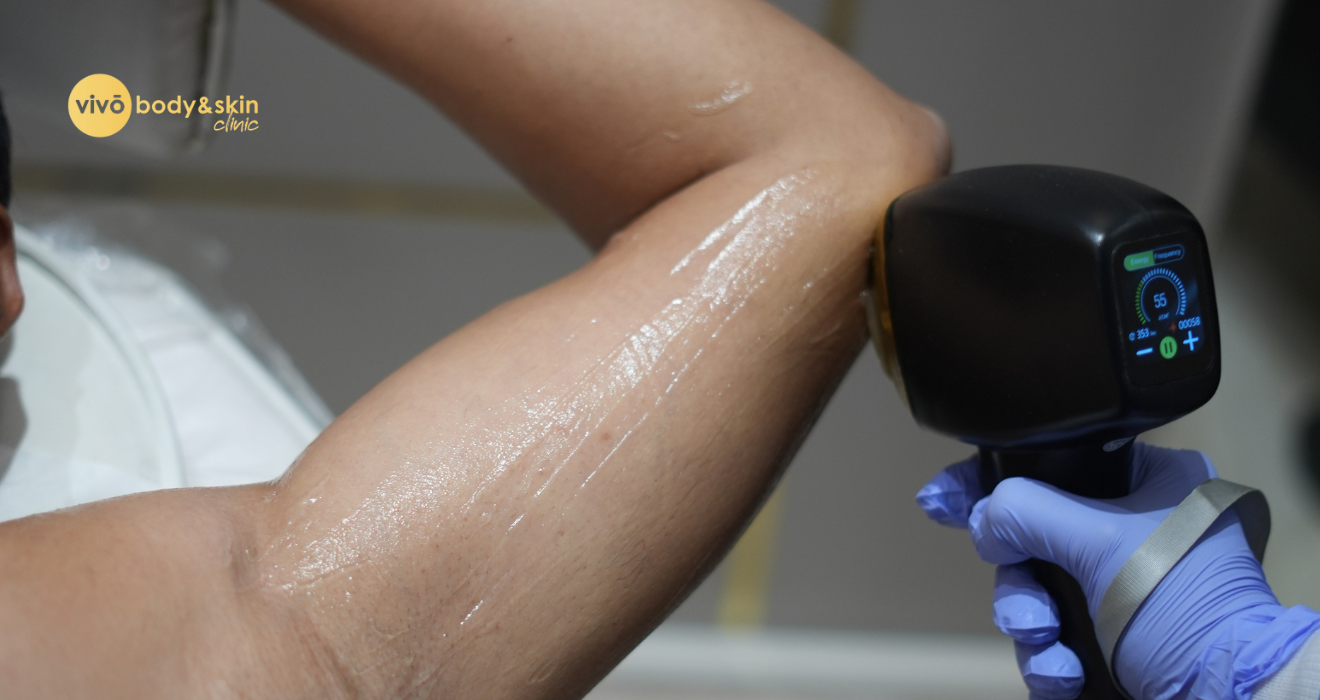
Laser hair removal is based on a scientific principle called selective photothermolysis. In simple terms, the laser emits a specific wavelength of light that is absorbed by the pigment (melanin) in the hair shaft and follicle. This light energy converts to heat, which damages the follicle and reduces its ability to grow new hair.
Because hair grows in cycles – active (anagen), transitional (catagen) and resting (telogen) phases – only a fraction of your follicles are in the ideal active phase at any one time. The laser works best on actively growing hairs, which is why multiple sessions spaced several weeks apart are needed to catch different follicles as they enter the growth phase.
A dermatology review on laser treatment of hirsutism notes that a single session typically reduces hair by around 10-40%, while a full course over several months can achieve up to 90% reduction, with results often lasting many months. The American Academy of Dermatology similarly reports that most patients need several sessions and that regrowth, when it happens, tends to be finer and less noticeable.
Does Laser Work for PCOS-Related Hair?
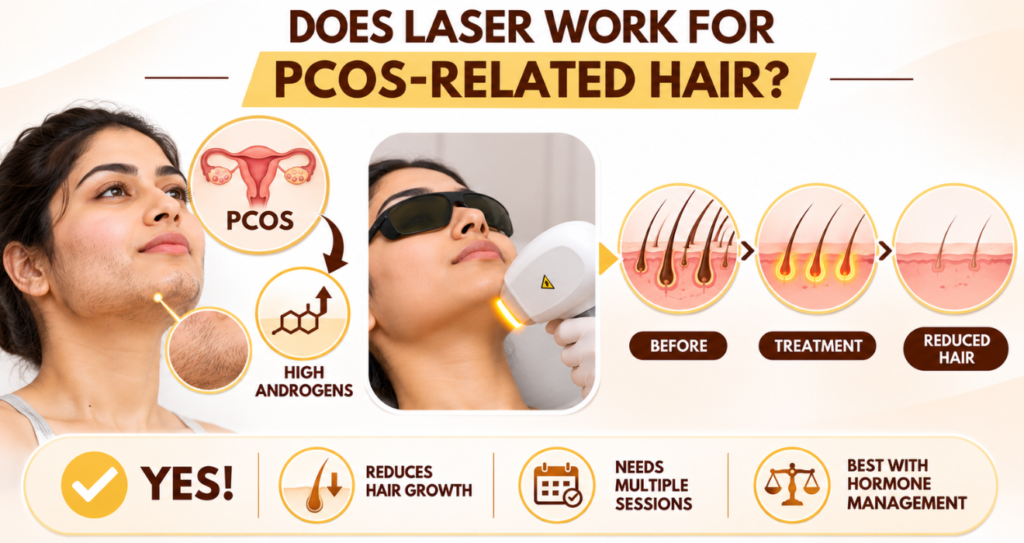
Yes – laser hair reduction does work for PCOS-related hair, and this is now supported by international guidelines. The 2023 international PCOS guideline specifically recommends mechanical laser and light therapies to reduce facial hirsutism and to help improve depression, anxiety and quality of life in women with PCOS.
However, there is an important caveat. PCOS-related hair tends to respond less completely and less durably than hirsutism with no hormonal cause (idiopathic hirsutism). The reason is simple: laser only treats the hair follicles that already exist. It does not switch off the underlying hormonal drive. In PCOS, androgens keep recruiting new follicles and converting fine hair to coarse hair, so new growth can appear over time.
One frequently cited observation is that women with higher androgen levels needed an average of around 8 laser sessions to reach meaningful reduction, compared with roughly 5-6 sessions in women with normal hormone levels. This is exactly why your treatment plan should be personalised rather than squeezed into a fixed package.
Why PCOS May Need More Sessions and Maintenance
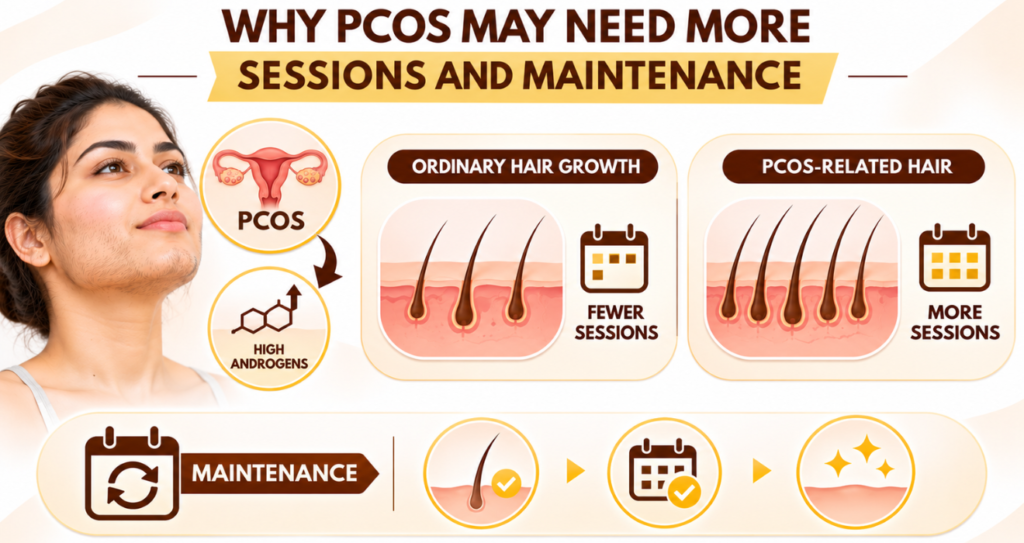
In women without a hormonal cause, 6-8 sessions often achieve excellent results. With PCOS, many women need around 8-12 sessions in the initial course, followed by occasional maintenance sessions.
This is not a sign that laser has failed. It reflects the biology of PCOS. Because the hormonal environment continues to activate new follicles, maintenance sessions every few months help keep hair to a comfortable minimum. Encouragingly, when PCOS is well managed – through lifestyle changes, weight optimisation and, where appropriate, hormonal therapy – the number of new hairs tends to fall, and maintenance intervals often lengthen.
Typical results you can expect
- After 1 session: roughly 10-25% reduction; hair may appear finer and grow more slowly.
- After 3-4 sessions: a noticeable, visible reduction in density on the treated areas.
- After 6-8 sessions: substantial reduction for most women; body areas often respond well.
- After 8-12 sessions: significant long-term reduction, though some fine facial hairs may remain and need maintenance.
These are general ranges, not guarantees. Individual results depend on your hormones, hair and skin.
Suitable Treatment Areas
Laser hair reduction can be used across most areas affected by PCOS hirsutism. Commonly treated areas include:
- Upper lip and chin
- Cheeks, jawline and sides of the face
- Neck
- Underarms
- Arms and forearms
- Chest and abdomen (including the lower abdomen)
- Back
- Bikini line and legs
In general, body areas such as the underarms, legs and bikini line tend to achieve more complete and longer-lasting results than the face, where hormonal influence is strongest. Facial hair usually responds well but is more likely to need ongoing maintenance.
Factors That Affect Your Results
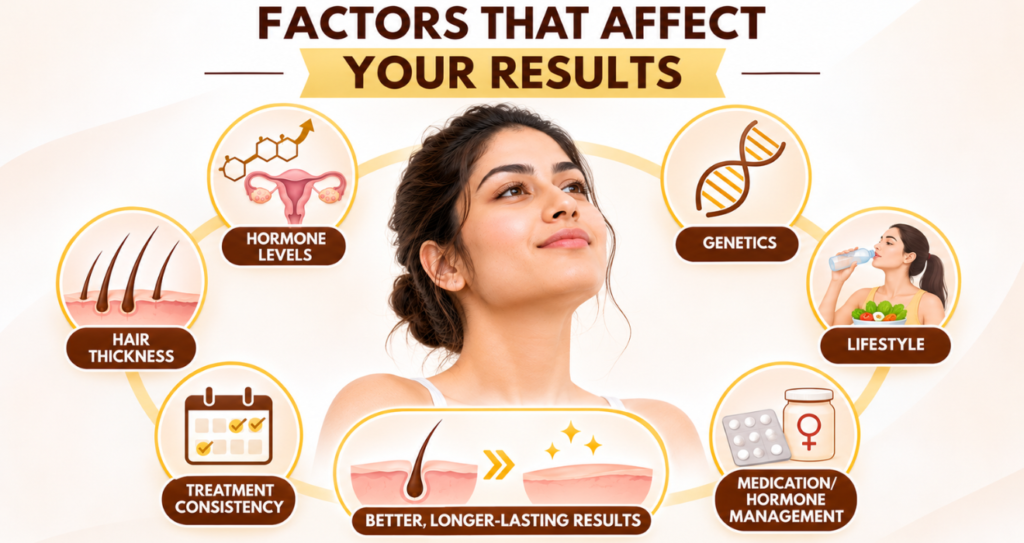
Several factors influence how well laser works for you:
- Hair colour: Laser targets pigment, so dark hair responds best. Blonde, grey, white or very fine ‘peach fuzz’ hair responds poorly because there is little melanin to absorb the light.
- Skin tone: Indian skin usually falls within Fitzpatrick types III-V. Darker skin requires careful device selection and settings to stay safe and effective.
- Hormonal activity: Higher androgen levels mean more ongoing follicle activation and therefore more sessions and maintenance.
- Treatment area: Facial hair is more hormonally driven and less predictable than body hair.
- Device and expertise: The right laser used at the right settings by a trained professional makes a significant difference to both results and safety.
Which lasers suit Indian skin?
For Indian skin tones, long-pulsed Nd:YAG (1064 nm) and diode lasers are commonly preferred because longer wavelengths penetrate deeper and are less absorbed by surface melanin, lowering the risk of burns and pigmentation. A randomised split-face trial published in the Indian Journal of Dermatology, Venereology and Leprology found that a triple-wavelength diode laser achieved around 74% hair reduction after four sessions in women with lower-face hirsutism and skin types III-V, outperforming IPL, with comparable safety.
Laser can permanently disable many hair follicles – but in PCOS, the hormonal drive keeps recruiting new ones. The honest goal is lasting reduction and comfort, not a guarantee of zero hair forever.
Can Laser Hair Removal Permanently Stop PCOS Hair Growth?
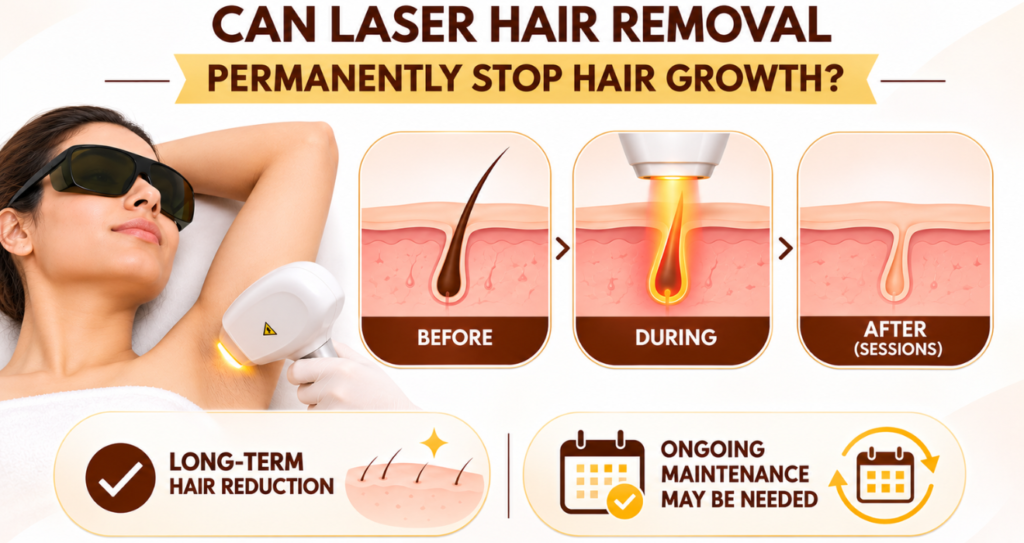
This is the question most women with PCOS want answered honestly, so here is the nuanced, medically accurate answer.
Laser hair removal can cause permanent hair reduction – a stable, long-term decrease in the number of terminal hairs – and it can permanently disable many individual follicles after a full course. On body areas, results can be very durable.
However, it cannot be truthfully described as permanent hair removal in PCOS. Laser treats follicles that exist today; it does not alter the hormones that keep producing new hair. Because PCOS involves an ongoing androgen influence, new follicles can become active over time, which is why maintenance sessions are usually part of the plan.
The more accurate and responsible way to think about it is this: laser offers significant, long-lasting reduction that makes daily life far more comfortable and reduces the distress hirsutism causes. It is a long-term management strategy, not a one-time cure. Any clinic that promises complete, permanent removal for PCOS hair is overpromising.
Laser vs Shaving, Waxing and Threading
Traditional hair removal methods only remove hair temporarily and must be repeated constantly. Laser reduces the hair itself over time. Here is a practical comparison.
| Factor | Laser Hair Reduction | Shaving | Waxing | Threading |
|---|---|---|---|---|
| How it works | Damages follicles with light energy | Cuts hair at skin surface | Pulls hair from the root | Twists and pulls hair out |
| Duration of results | Long-term reduction | 1-3 days | 2-4 weeks | 1-3 weeks |
| Reduces hair over time | Yes | No | No | No |
| Suits facial hirsutism | Yes, with maintenance | Temporary only | Can irritate | Common for face |
| Ingrown hairs / irritation | Usually reduces them | Possible | Common | Possible |
| Upfront cost | Higher | Very low | Low per visit | Low per visit |
| Long-term cost / effort | Lower over years | Ongoing forever | Ongoing forever | Ongoing forever |
Importantly, you should avoid waxing, plucking and threading in the weeks before a laser session, because these remove the hair root and reduce the pigment the laser needs to target. Shaving is fine between sessions, as it trims the hair while leaving the follicle intact.
Laser Hair Removal for PCOS: Benefits and Considerations
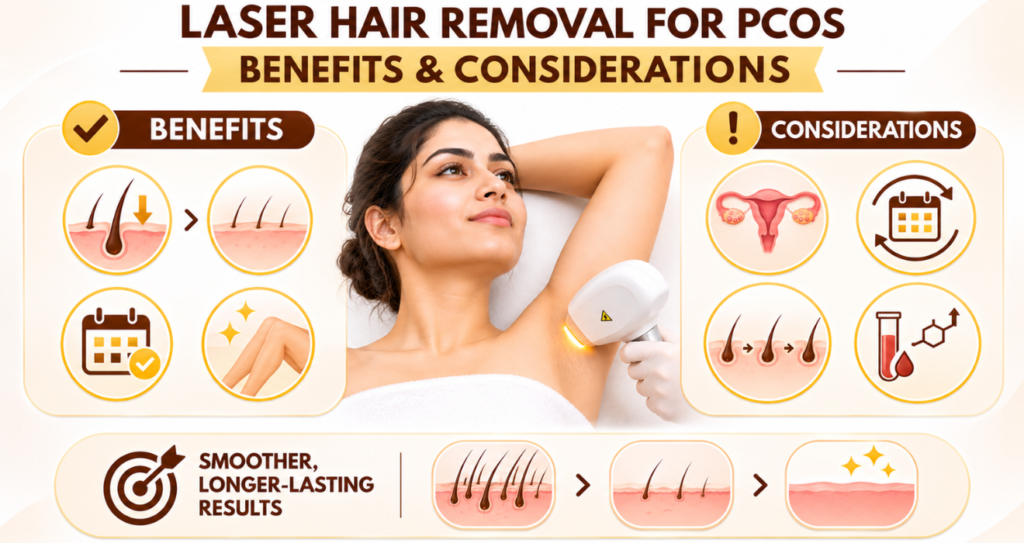
Safety for Indian Skin
Laser hair removal has a strong safety record when performed by trained professionals using appropriate equipment. For Indian skin tones, safety depends heavily on selecting the right laser and settings.
Longer-wavelength lasers (such as Nd:YAG) and diode systems with integrated cooling are generally preferred for Fitzpatrick types III-V because they reduce the risk of burns and pigmentation. The 2023 PCOS guideline notes that adverse effects are limited when procedures are carried out by experienced, suitably qualified providers, which is why choosing your clinic carefully matters.
Treating tanned or sun-exposed skin increases the risk of blistering and pigment changes, so sun protection before and after treatment is essential. A test patch is a standard precaution, allowing the clinician to check your skin’s response before treating a full area.
How to Prepare for Treatment
A little preparation improves both safety and results:
- Avoid sun exposure and tanning for a few weeks before your session.
- Stop waxing, plucking and threading for 2-4 weeks beforehand – shaving is fine.
- Shave the area a day or so before, as advised by your clinician.
- Avoid perfumes, deodorants or heavy creams on the treatment area on the day.
- Tell your clinician about any medications, skin conditions, melasma or a tendency to pigmentation or keloids.
If you are planning treatment around a festival or event, timing matters because you need several sessions spaced weeks apart. Our guide on when to start laser hair removal before Diwali explains how to plan ahead, and you may also find our advice on booking aesthetic treatments for the festive season useful.
Aftercare and Temporary Reactions
Mild reactions after treatment are normal and usually settle within one to three days. These can include:
- Redness and mild swelling around the follicles
- A warm, slightly tender sensation like mild sunburn
- Temporary darkening or lightening of the skin in some cases
To support healing, apply a gentle moisturiser, avoid hot showers, saunas, swimming and intense exercise for a day or two, and protect the area with broad-spectrum sunscreen. Avoid scrubbing or other hair removal methods between sessions apart from shaving.
Serious reactions such as burns, blistering or lasting pigment change are uncommon and are far more likely with inexperienced operators or incorrect settings – another reason to choose a reputable clinic.
Who Should Postpone or Avoid Treatment
Laser hair removal is not suitable for everyone, or not at every time:
- Pregnancy: Although laser only affects the skin’s surface, it is an elective procedure and hormonal changes make results less predictable, so most clinicians advise waiting until after pregnancy. Breastfeeding is generally fine as long as the breast area is not treated.
- Active skin infection or tan: Treatment should be delayed until the skin has recovered.
- Recent sun exposure or certain photosensitising medications: Discuss with your clinician.
- History of keloids or significant pigmentation disorders: Requires cautious, individualised settings.
- Very light or fine hair: Laser is unlikely to be effective.
Your clinician will review your history and skin type at consultation and advise whether to proceed, adjust or postpone.
Why Treating the Underlying PCOS Still Matters
Laser addresses the hair you can see, but it cannot fix the hormonal cause of that hair. Managing PCOS itself is what reduces ongoing hair growth and, over time, lowers how much laser maintenance you need.
International guidelines consider combined oral contraceptive pills first-line for hyperandrogenism, with anti-androgens added where appropriate, and lifestyle measures such as weight optimisation and physical activity as a foundation of care. Studies suggest that combining hormonal therapy with laser can produce greater and more sustained hair reduction than laser alone.
In short, the best outcomes come from a combined approach: medical management of PCOS alongside laser hair reduction. This is why a dermatologist and, where relevant, a gynaecologist or endocrinologist should be involved.
When to see a dermatologist or gynaecologist
Consider a medical review if you have not yet been formally diagnosed with PCOS, if your hirsutism appeared suddenly or is worsening quickly, if you have irregular periods, acne or hair thinning, or if you are planning pregnancy. These professionals can confirm the diagnosis, check hormone levels where needed and tailor both medical and laser treatment to you.
Laser Hair Removal for PCOS in Mumbai: Cost & Consultation
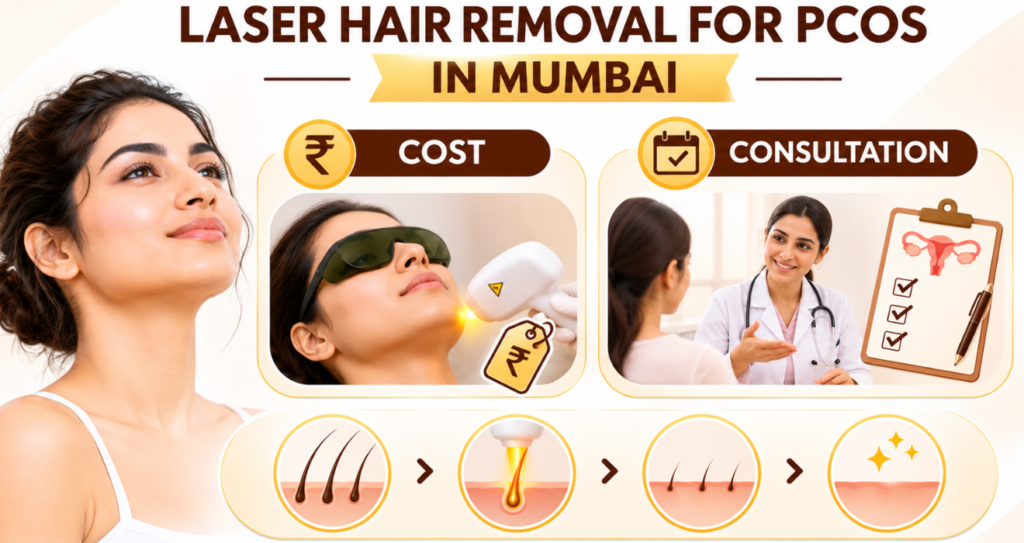
Laser hair removal in India is priced by treatment area and the number of sessions, and the right plan for PCOS is best determined after an in-person assessment. Because PCOS often requires more sessions than average, it is sensible to think about the full course and likely maintenance rather than only the first session.
At Vivo Body & Skin Clinic in Mumbai, we provide an exact, personalised quote after assessing your skin type, hair and treatment areas during consultation. This ensures your plan is realistic and tailored, rather than a one-size-fits-all package.
During your consultation we will evaluate your suitability, discuss how many sessions you may need, explain expected results and answer your questions honestly. To arrange a personalised assessment, simply book a consultation with our team and we will guide you through your options.
Why Choose Vivo Body & Skin Clinic?
Treating PCOS-related hair well requires more than a laser – it requires understanding of the hormonal background, the right technology for Indian skin and a realistic, personalised plan.
At Vivo Body & Skin Clinic in Mumbai, our experienced team uses advanced aesthetic technology to deliver safe, effective results. What sets our approach apart:
- Personalised assessment: We evaluate your skin type, hair and hormonal context before recommending treatment.
- Suitability evaluation: We carry out a test patch and tailor settings to your skin tone for safety.
- Professional guidance: We set honest expectations about sessions, results and maintenance.
- Treatment planning: We build a plan around your needs, not an arbitrary package.
We offer a range of non-invasive aesthetic treatments, so if hormonal weight changes are also part of your PCOS journey, you may find our guidance on topics such as medical weight management consultations in Mumbai and facial rejuvenation options helpful too. If vaginal laxity after childbirth is a concern, our overview of treatment options may be useful.
Ready to take the first step? Book a consultation with Vivo Body & Skin Clinic to discuss a personalised laser hair reduction plan for your PCOS.
Is laser hair removal safe for PCOS?
Yes. International PCOS guidelines recommend laser and light therapies for facial hirsutism, and they are considered safe when performed by trained professionals using appropriate devices. For Indian skin tones, lasers such as Nd:YAG and diode are commonly chosen to reduce the risk of burns and pigmentation. A test patch and careful settings help keep treatment safe.
How many laser sessions do I need for PCOS hair?
Most women with PCOS need around 8-12 sessions in the initial course, compared with 6-8 for women without a hormonal cause. This is because PCOS continually activates new hair follicles. Maintenance sessions every few months are usually needed afterwards. The exact number depends on your hormones, hair and treatment area.
Can laser permanently remove PCOS facial hair?
Laser can permanently disable many follicles and achieve long-term hair reduction, but it is not accurate to promise permanent removal of all hair in PCOS. Because the hormonal drive continues, new hairs can appear over time, which is why maintenance is part of the plan. The realistic goal is significant, lasting reduction and greater comfort.
Does laser work on dark skin tones common in India?
Yes. Long-wavelength lasers such as Nd:YAG and modern diode systems with cooling are well suited to Fitzpatrick skin types III-V. A split-face trial in Indian women with lower-face hirsutism showed strong results with a triple-wavelength diode laser and a good safety profile. The key is choosing a clinic experienced in treating Indian skin.
How much does laser hair removal for PCOS cost in Mumbai?
Cost depends on the treatment areas and the number of sessions, and PCOS often requires more sessions than average. At Vivo Body & Skin Clinic, we provide an exact, personalised quote after assessing your skin and hair during consultation, so your plan is realistic rather than a fixed package.
Will I still need to shave between laser sessions?
Yes, shaving is allowed and recommended between sessions, as it trims the hair while leaving the follicle intact for the laser to target. You should avoid waxing, plucking and threading in the weeks before each session, because these remove the hair root and reduce the laser’s effectiveness.
Can I have laser hair removal while on PCOS medication or the pill?
In most cases, yes, and combining laser with hormonal therapy such as combined oral contraceptive pills can actually improve and sustain results by reducing new hair growth. Always tell your clinician about any medications you take, as some can affect skin sensitivity. Your gynaecologist or dermatologist can coordinate your overall plan.
Does laser hair removal hurt?
Most people describe a mild snapping or warm sensation rather than severe pain. Sensitive areas such as the upper lip and bikini line can feel more uncomfortable. Modern lasers use cooling to reduce discomfort, and lower-fluence settings can be less painful while still effective. Any discomfort should be brief and tolerable.
Is it better than waxing or threading for PCOS?
For persistent PCOS hirsutism, laser offers something waxing and threading cannot: genuine long-term reduction of the hair itself, rather than temporary removal. It also tends to reduce ingrown hairs and irritation. Waxing and threading remain useful for quick touch-ups, but they must be repeated indefinitely and can irritate the skin.
When should I see a doctor about PCOS hair growth?
See a dermatologist or gynaecologist if you have not been formally diagnosed, if hair growth appeared suddenly or is worsening quickly, or if you have irregular periods, acne or scalp hair thinning. Treating the underlying PCOS alongside laser gives the best long-term results and reduces how much maintenance you will need.