
Why Timing Matters as Much as the Treatment Itself
The Indian festive calendar – from Navratri garba nights and Durga Puja to Diwali card parties and the wedding season – is intensely visual and social. Elaborate outfits, gold jewellery, high-definition photography and late evenings under bright lights all raise the stakes when it comes to how your skin looks and feels.
It is tempting to book an aesthetic treatment in the final days before a celebration, hoping for an instant transformation. In reality, the single most important factor in achieving clear, radiant festive skin is not which treatment you choose, but when you book it.
Many effective skin treatments – including chemical peels, microneedling and certain lasers – work by creating controlled, microscopic injury that stimulates the skin to repair and renew itself. By design, this can cause temporary redness, swelling, flaking or crusting that lasts anywhere from a day to a few weeks. Booked too close to your event, these normal healing responses can leave you with visible redness or uneven tone during the celebration rather than the glow you hoped for.
At Vivo Body & Skin Clinic in Mumbai, we plan treatment timelines around your event dates, your skin type and your individual concerns – because good festive skin preparation is really about thoughtful scheduling and realistic expectations.
Why Indian Skin Needs a More Conservative Timeline
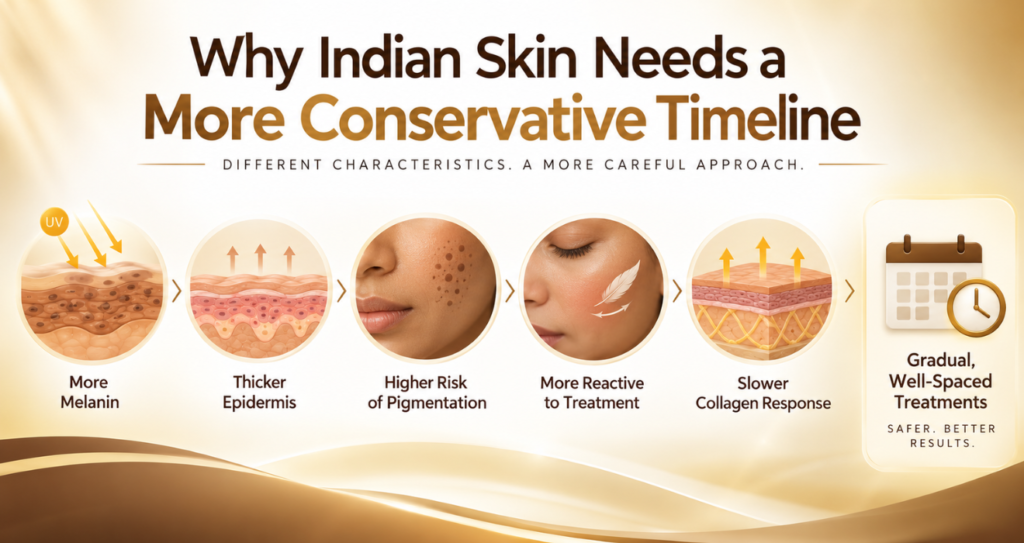
Most people in India fall into Fitzpatrick skin types III to V, which carry more melanin. This offers some natural protection against the sun but also makes the skin more prone to post-inflammatory hyperpigmentation (PIH) – dark marks that appear after inflammation or injury.
When deeper skin is treated or inflamed, the pigment-producing cells can become overactive, leaving brown patches that may take weeks or even months to fade. Systematic reviews of fractional laser resurfacing note that PIH in darker skin usually settles within one to three months, but in some cases can persist for up to six months, according to research published via the US National Library of Medicine (PubMed).
The festive season compounds this. It often coincides with high ultraviolet levels, long outdoor events, late nights and exposure to firecracker smoke and dust. All of these can aggravate recently treated skin. This is precisely why a schedule that might suit lighter skin in a cooler climate needs to be more cautious here – a safety buffer measured in weeks rather than days is often wisest.
It also explains why a reputable clinic will insist on a proper assessment first. Melasma, PIH and simple tanning look similar but are different conditions requiring different approaches. Treating them identically with generic peels or brightening creams tends to disappoint – and, close to a festival, can do more harm than good.
Corrective Versus Glow Treatments: Know the Difference
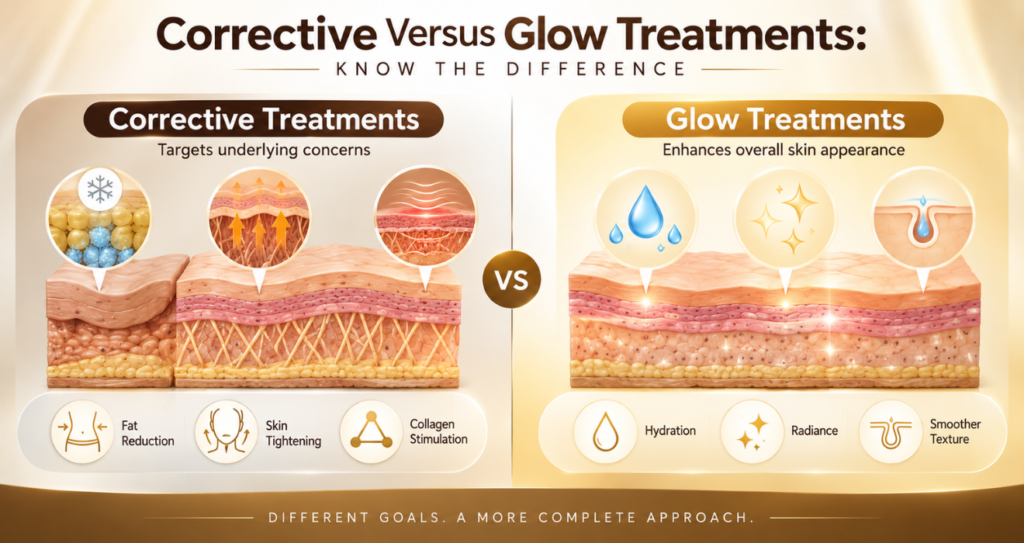
Understanding one simple distinction will save you a great deal of stress when planning around festivals.
Corrective treatments
These address underlying concerns such as acne scars, stubborn pigmentation, melasma and uneven texture. Examples include microneedling, medium chemical peels and certain lasers, as well as technologies that stimulate collagen deep within the skin. They usually require several sessions spaced weeks apart, and their benefits build gradually over months – not overnight. The early stages may even make skin look slightly worse before it improves.
Enhancement or “glow” treatments
These deliver relatively immediate improvements in hydration, brightness and smoothness with minimal or no downtime. A HydraFacial is the classic example – often described as the treatment you book before an event, not after. These are the treatments best suited to the final days before a celebration.
The common mistake is expecting a deep corrective treatment to behave like a quick glow facial when booked on the eve of celebrations. Corrective work needs a long runway; enhancement work can be layered closer to the big day.
Your Festive Treatment Timeline at a Glance
Below is a practical overview of common treatments and how far ahead of a major event they are typically best scheduled. These are general guidelines only – your actual timeline depends on your specific treatment, skin condition and your practitioner’s assessment.
| Treatment | Typical visible downtime | Recommended minimum before your event |
|---|---|---|
| HydraFacial / medi-facial | None; glow peaks at 24-48 hours | Day before or same day |
| Superficial chemical peel | Redness and light flaking, 3-7 days | At least 7-10 days |
| RF skin tightening | Mild redness, often hours only | Start a series 4-8 weeks ahead |
| Microneedling | Redness and flaking, a few days to a week | At least 7 days per session; begin 2-3 months ahead |
| HIFU (ultrasound skin lifting) | Minimal; occasional mild tenderness or redness | 6-8 weeks for visible lifting to develop |
| Plasma Eye Lift | Small crusting around the eyes, typically 5-10 days | At least 4-6 weeks before the event |
| Medium chemical peel | Redness, crusting, 7-14 days | At least 14 days; ideally earlier |
| Deep peel / ablative laser resurfacing | Weeks of redness; PIH risk for months | Avoid within 2-3 months of festivals |
Notice how treatments cluster into two groups: long-lead corrective work and short-lead glow treatments. Mapping your chosen treatment onto this spectrum is the key to stress-free planning.
6-8 Weeks Before: Begin Your Corrective Work
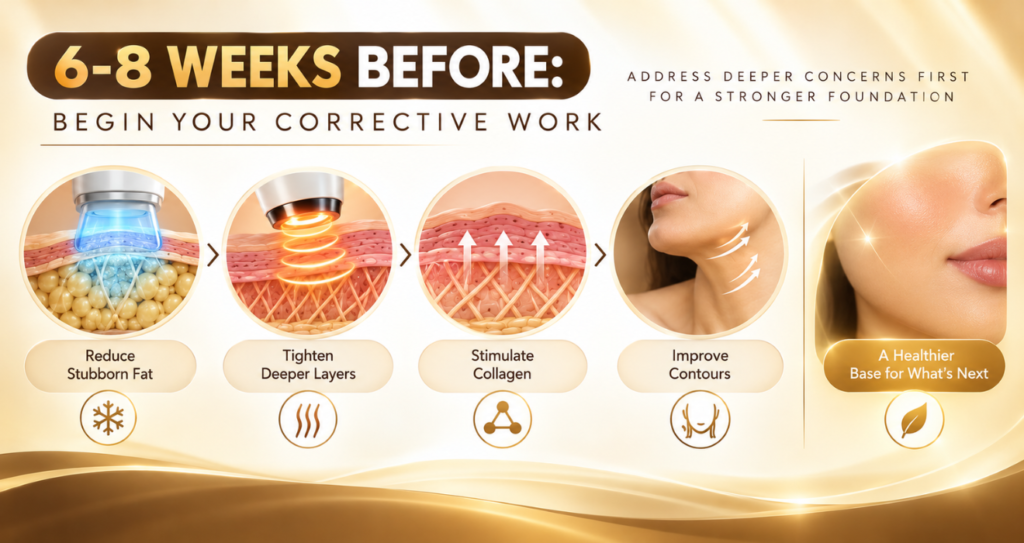
This is the ideal window to start anything that genuinely changes your skin’s structure or addresses longstanding concerns. It allows time for an assessment, multiple sessions where needed, and for results to settle well before your event.
HIFU for lifting and firmness
High-Intensity Focused Ultrasound (HIFU) uses focused ultrasound energy to stimulate collagen deep beneath the skin, gradually lifting and firming areas such as the jawline, cheeks and neck. Crucially, HIFU results are not instant – they develop gradually over 6 to 12 weeks as new collagen forms. This makes it a treatment to book well in advance, not in the final fortnight. If a lifted, more defined facial contour is your festive goal, the 6-8 week mark is often the latest sensible point to begin. We explore how it compares with other options in our guide to facial rejuvenation with HIFU, RF and microneedling.
Microneedling for scars and texture
Microneedling creates thousands of controlled micro-channels that trigger collagen production, softening acne scars and refining texture over time. Because it spares most of the surface skin, it carries a relatively low PIH risk compared with some lasers – a genuine advantage for Indian skin. A randomised study published via PubMed found significant improvement in atrophic acne scars after a short series of sessions, with only mild, transient redness. Results build over three to six months, so starting early is essential.
Plasma Eye Lift for the eye area
A Plasma Eye Lift is a non-surgical option for tightening loose or crepey skin around the eyes. It typically produces small crusts around the treated area that lift over 5 to 10 days, followed by continued tightening as the skin heals. Because the eye area is so prominent in festive photographs, allowing a comfortable 4 to 6 weeks for complete healing and settling is strongly advised.
The safest festive glow is planned, not improvised. Begin corrective work months ahead, and reserve the final 48 hours for gentle, no-downtime treatments.
4 Weeks Before: Firming, Toning and Final Corrective Touches
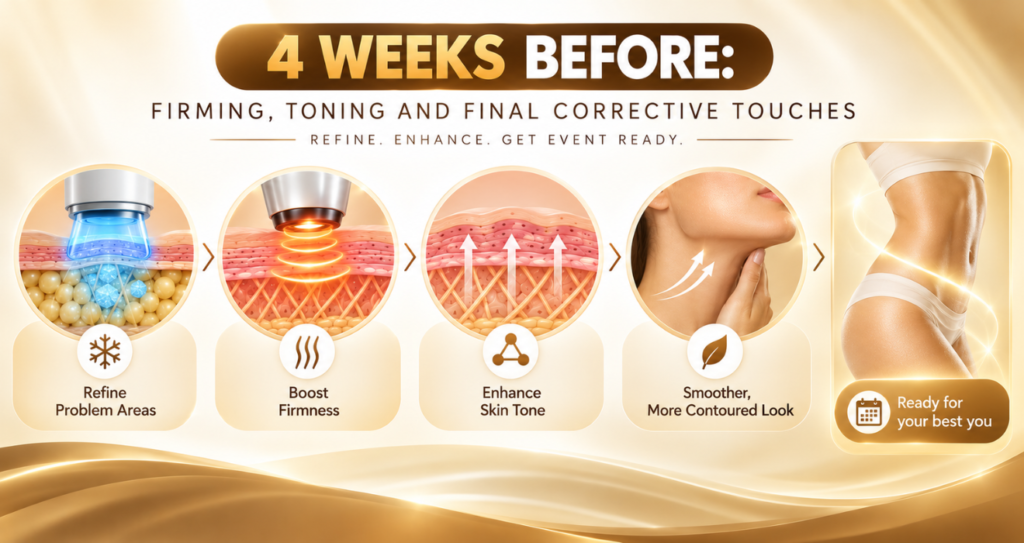
At the four-week mark, the emphasis shifts to treatments with modest downtime and reliable, visible benefits.
RF skin tightening
Radiofrequency (RF) skin tightening gently heats the deeper layers of skin to stimulate collagen and improve firmness, with little to no visible downtime – usually only brief redness. A course of sessions in the weeks leading up to a festival can enhance firmness and that sought-after “tightness” along the jaw and cheeks. Because it is so low-downtime, RF is a flexible, forgiving choice for festive preparation and is popular with those addressing laxity, including after weight changes. If skin firmness is your concern, our overview of non-surgical skin tightening options explains how these technologies work.
This is also a sensible window to complete a final microneedling session or a planned non-ablative laser treatment, allowing roughly two weeks of recovery with plenty of buffer. It is generally too late, however, to begin an entirely new series of deeper corrective treatments.
2 Weeks Before: Fine-Tuning Only
Two weeks out, you should be refining – not launching major new projects. A superficial chemical peel performed at least a week before your event can lift dullness and smooth texture, with light flaking resolving in good time. A final RF session also sits comfortably here thanks to its minimal downtime.
What to avoid now: medium or deep peels, fresh microneedling on sensitive skin, and any treatment likely to leave visible redness or crusting. This is the point at which overdoing exfoliating acids, retinoids and scrubs in a last-minute “detox” tends to backfire, compromising the skin barrier and causing irritation rather than radiance.
Booking Treatments Close to a Festival: An Honest Look
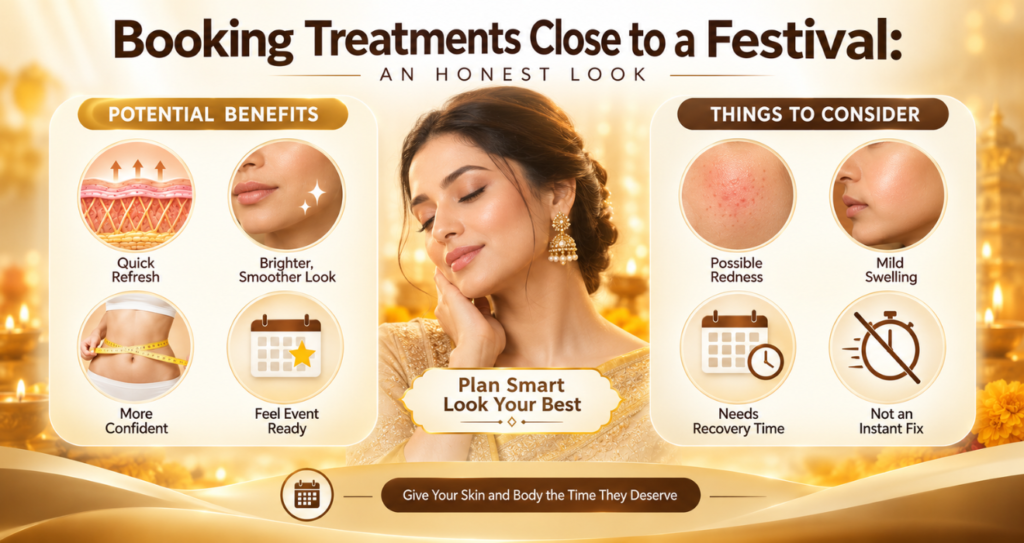
5-7 Days Before: Glow Treatments and Calming Care
In the final week, the focus turns firmly to gentle, no-injury treatments. A HydraFacial scheduled a few days ahead cleanses, exfoliates and deeply hydrates the skin, delivering a visible glow that peaks in the 24 to 48 hours afterwards. There is no peeling or redness, and makeup can be applied immediately.
This is also the time to keep your routine simple and calming: a gentle cleanser, a good moisturiser and daily broad-spectrum sunscreen. Resist the urge to introduce anything new. If you are managing acne or a sensitive patch of skin, now is the moment for soothing care, not experimentation.
24-48 Hours Before: The Finishing Touch
In the day or two before Navratri, Diwali or a wedding, the safest and most effective choice is a no-downtime glow treatment. A HydraFacial the day before – or even the morning of an evening event – leaves skin hydrated, smooth and luminous, with no restriction on makeup.
What you should not do in this window is begin any new corrective procedure. Medium peels, microneedling, lasers and injectable fillers all carry responses that would overlap awkwardly with your celebration. This is a time for rest, hydration, sun protection and gentle finishing touches – not therapeutic interventions.
Beyond skin treatments, remember that festive prep for many involves broader body and wellness goals too. If you are working towards a weight or body-shape goal for the season, our articles on body contouring after weight loss and non-surgical stretch mark reduction may be useful reading – though, like skin correction, these are best planned well ahead rather than in the final days.
Setting Realistic Expectations
Social media filters and advertising promise overnight transformation, but genuine skin improvement follows the biology of healing. Treatments such as microneedling, HIFU and RF deliver their best results gradually – often over three to six months – as collagen remodels. Pigmentation and acne scars rarely vanish in a single session.
A trustworthy clinic will be honest about this. Rather than promising miracles before Diwali, the goal is a realistic, individualised plan that respects your skin type, your timeline and your budget. For many people, a well-timed HydraFacial plus a sensible skincare routine delivers more satisfying festive results than an expensive, rushed course of deep treatments begun too late.
Why Choose Vivo Body & Skin Clinic?

Vivo Body & Skin Clinic in Mumbai offers a range of affordable, non-invasive aesthetic treatments, from HydraFacial and RF skin tightening to HIFU and the Plasma Eye Lift. Our experienced team uses the latest pioneering aesthetic technology to deliver results tailored to Indian skin and the realities of the festive calendar.
Because safe, satisfying outcomes depend on the right treatment at the right time, every plan begins with a proper assessment of your skin, your concerns and your event dates. If you are preparing for Navratri, Diwali or the wedding season, the best time to start the conversation is now. Book a consultation with Vivo Body & Skin Clinic to build a festive skin plan that works for you.
How late is too late to book a skin treatment before Diwali or a wedding?
As a general rule, one week before a major event is too late to begin any treatment that involves controlled injury – such as medium peels, microneedling or lasers – especially if you have never had it before. These can cause redness, flaking or crusting that may still be visible during your celebration. If only a week remains, focus on no-downtime glow treatments like a HydraFacial and a gentle, calming skincare routine instead.
What is the safest treatment to book just before a festive event?
A HydraFacial or a gentle professional medi-facial is the safest last-minute choice. It cleanses, exfoliates and hydrates without injuring the skin, so there is no redness or peeling, and you can wear makeup immediately. The glow peaks in the 24 to 48 hours afterwards, making it ideal the day before or the morning of an event.
How far in advance should I start HIFU for a lifted look?
HIFU results develop gradually over roughly 6 to 12 weeks as new collagen forms, so it should be booked well in advance – ideally 6 to 8 weeks before your event at the latest. It is not a last-minute treatment. Your practitioner will advise on the right timeline based on your skin and the areas being treated.
Can I have RF skin tightening close to a festival?
RF (radiofrequency) skin tightening has little to no visible downtime – usually only brief redness – so it is relatively forgiving in the weeks before an event. That said, it works best as a short course over several weeks, with firming results building gradually, so starting four or more weeks ahead gives the best outcome.
Is it safe to use home microneedling devices or DIY peels before festivals?
These carry real risks, particularly in the days before an important event. Regulators including the US FDA warn that microneedling devices can cause bleeding, bruising, infection and pigment changes if used incorrectly. Strong home peels can cause burns and post-inflammatory hyperpigmentation, which is especially problematic for Indian skin. Treatments that pierce or resurface the skin are safest in trained, professional hands.
Why is Indian skin more prone to dark marks after treatment?
Most Indian skin is richer in melanin (Fitzpatrick types III to V), and the pigment-producing cells react strongly to inflammation or injury. This increases the risk of post-inflammatory hyperpigmentation – dark marks that can take weeks or months to fade. This is why timelines for darker skin should be more conservative, with careful sun protection afterwards.
How should I treat melasma or acne marks before festivals?
These chronic concerns need advance planning, ideally starting two to three months before your event. Melasma, post-inflammatory hyperpigmentation and simple tanning look similar but require different approaches, so an accurate assessment is essential. Expecting dramatic lightening in the final week is unrealistic and often leads to overusing harsh products that irritate the skin.
Can I have a Plasma Eye Lift before a wedding or festive event?
Yes, but with adequate lead time. A Plasma Eye Lift typically causes small crusts around the eyes that lift over 5 to 10 days, with tightening continuing as the skin heals. Because the eye area is so prominent in photographs, allow at least 4 to 6 weeks for complete healing and settling before your event.
Will one treatment give me the glow I want?
A HydraFacial can deliver an immediate, visible glow in a single session, which is why it is so popular before events. However, corrective treatments for scars, pigmentation and firmness – such as microneedling, HIFU and RF – build results over multiple sessions and several months. Setting realistic expectations is an important part of any good plan.
What should I avoid doing to my skin in the final 48 hours?
Avoid starting any new corrective procedure, introducing unfamiliar active ingredients, or layering multiple exfoliating acids, retinoids and scrubs in a last-minute attempt to ‘detox’. This can damage the skin barrier and cause redness or burning. Keep to gentle cleansing, moisturising, sun protection and, if you wish, a no-downtime glow facial.